



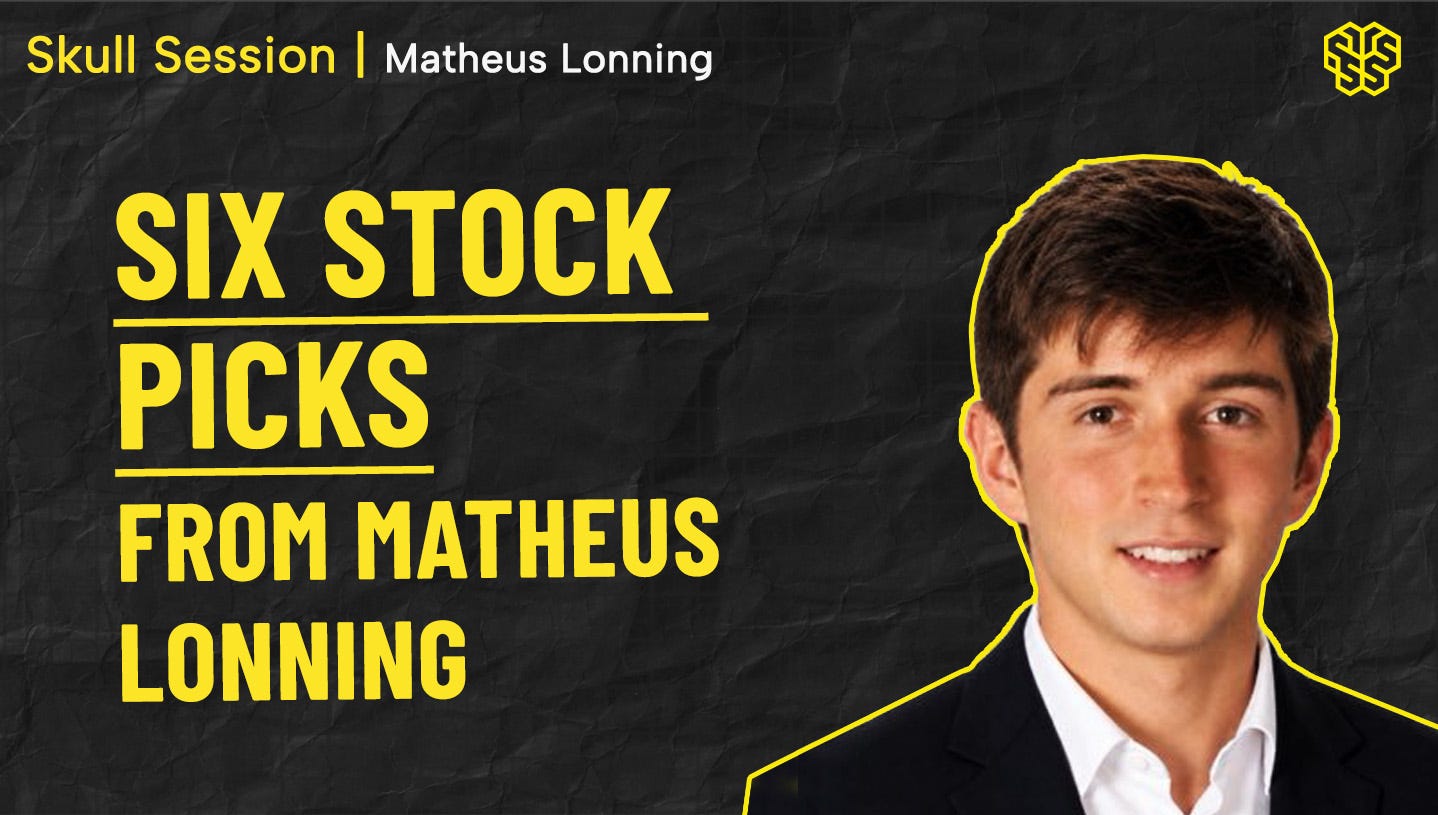
I recently came across Matheus Lonning while perusing “X” at 1 AM, sitting and having a few drinks at the El Camino Restaurant on Las Olas Boulevard in downtown Fort Lauderdale. El Camino is Spanish for “the path”. Like many young investors these days, Matheus’ path reminds me of the one I took when I was fortunate enough to discover the world of small and microcap investing and the ROI that came from hard work. Matheus has built a following through his Substack and X by digging into obscure microcaps, reading filings, talking directly with management teams..
Matheus’s approach is pretty straightforward. He looks for companies with strong balance sheets, limited coverage, improving fundamentals, and a valuation that does not seem to reflect the opportunity. He is also comfortable making an initial investment before doing every piece of research, then digging deeper as he learns more about the business. This is extremely aligned with how I invest. That willingness to act independently comes through throughout the interview, especially when he talks about how headline-driven market reactions can create opportunities in small, thinly followed companies. Interestingly, one of his first exposures to the stock market was through a stock contest, similar to my journey.
We get into several of those situations in the Q&A below, including Table Trac, Trio-Tech, SCIA, and a few aerospace and defense names Matheus is watching. He also explains what he looks for when speaking with management, how he tries to distinguish a genuinely misunderstood company from a stock that is simply cheap for a reason, and how some of his ideas played out after he first wrote about them.
Skull Sessions is a collaboration with Geoinvesting.com, a full-stack microcap research platform and MS Microcaps LLC , home of the Microcap Quality Index (MSMqi).
1. How did you first get into investing? Tell us about your journey before and after investing. What is your investing framework and research process like today and how has it evolved over time? When a new idea enters your radar, what does your process look like before you’re willing to invest?
I started investing when I was in High School. There was this “stock contest” where we were paper trading for the entire school year and eventually crown a school champion. Most people just bought something like Apple or Microsoft and forgot about it for the whole year. I was super into it though. I did start by buying whatever company I felt was cool, like Lockheed Martin or Nvidia or Dell, but eventually I started to just buy whatever names were trending regardless of whether I knew the “brand” or not, it was a fun contest and although I was not the winner, it was a great experience.
Nowadays I have graduated from buying whatever is trendy or well-known to buying as obscure businesses as I can. Ideally, these businesses have no analyst coverage and very little chatter on social media.
I usually start with a screener, or sometimes I see a stock go up after earnings and dig deeper. I look for downside protection initially. Is there any debt? What does the balance sheet look like? I prefer businesses with a fairly large cash pile and no debt, but not having that is not automatically a deal breaker. Then, I look at growth, sector tailwinds, peer comparisons and whatever info I can find. With that being said, a lot of these small companies have limited information available online. That is where speaking to management teams can have an advantage. A big part of investing in these lesser known companies is figuring out whether you can trust management or not. That makes or breaks a thesis.
I am a “buy first, ask questions later” person. My best returns have resulted from when I did little research initially and just bought and understood the company later. Overthinking is a bitch. Usually a good pitch is a few sentences long and goes along the lines of: lots of cash, no debt, growing faster than peers but at a lower multiple. Bang.
2. If someone asked what makes you different as an investor, what would you say is your edge?
I am not going to sit here and tell the world I have an untouchable edge when it comes to investing. I do not. What separates me from the average investor, is the ability to think for myself and reach conclusions where there is not a consensus already formed.
I am willing to read filings, speak to management teams and then decide for myself whether or not this is a good investment. I don’t need MS or GS to have a buy rating and high price target to place my money. Usually when analysts start to put out high targets on specific companies it is already too late and the bulk of the returns have already been made.
In short, my willingness to make decisions based on my own reading of a situation allows me to target companies where few others are looking at and that is how you outperform the broader consensus markets.
3. What kinds of companies or investment opportunities are catching your attention right now? What are up to three stocks you’re particularly excited about today, and what do you think the market is overlooking?
I think the aerospace/defense sector is attractive and overlooked even as the US gov pleads to restock ammunition stockpiles, I think the whole sector is going to over earn soon and it is not priced in. My top picks in the sector are: $BUKS, $TAYD, CVU.
4. You’ve written about several companies where the market appears to be focusing on the obvious negative, while you’re focused on an underlying inflection. How do you determine when the market is missing an important change in a business versus when you’re simply rationalizing a cheap stock that deserves to be cheap?
The market has become over fixated on headlines. It has overreacted to both upside and downside without seeing the whole picture. By reading an entire press release or 10k/q one can find real alpha.
Recent examples are overreactions on TAYD, SIF, or even PPIH BUKS. Reactions were quickly corrected and there was fast money to be made by understanding the entire picture.
OK, now let’s talk about stocks. I noticed that there’s a bunch of companies that you talk about that I recognize.
5. In your recent Table Trac ($TBTC)piece, you wrote that speaking directly with management allowed you to learn things that simply weren’t available in the filings, particularly because the company has essentially no analyst coverage. After doing this repeatedly, what are the specific things you listen for in a management conversation that can materially change your investment thesis? What did you particularly learn about TBTC that piqued your curiosity and gave you differential insights? Can you give us an idea of what’s changed in the model and why activist, Chuck Gilman, might have just got involved?
I am basically looking to learn if I can trust them or not, usually promotional CEOs can not be trusted and will line their own pockets before those of shareholders. When a CEO focuses on the business and not the stock that is when I become even more interested.
TBTC chatter with CEO Randy Gilbert was delightful. He gave me an in depth description on how their machines work and what their plan is for the future. I also learned that their actual moat comes from cybersecurity within their software systems. Now I value the company as a SaaS business with high margin recurring revenues, instead of focusing on lumpy system sales.
Chuck Gilman is not involved with the company, it was a mistake proxy transaction causing some confusion. With that being said, I think TBTC will be a long term compounder and find shares attractive even after the recent run.
7. Your Trio-Tech ($TRT) thesis relies heavily on the idea that at a company this small, winning even one additional meaningful semiconductor customer could have a disproportionate impact on revenue and EPS. How do you model that kind of nonlinear upside without falling into the trap of building a valuation around hypothetical customers that may never materialize? Also, from my own experience with the company for three decades, I’ve really never seen their ability to expand margins. Does that concern you? Or is the set-up just more of one, where revenue scales so that even at current margins, the company becomes profitable? .
At the time of my article, TRT was trading around $4 a share. I projected that receiving just one extra order could have a meaningful impact, they received two massive orders in the subsequent weeks/months causing the stock to reach over $20 a share after a strong earnings report. It was a massive realized winner for my book this year.
With TRT I was more worried about revenue growth and taking advantage of the semiconductor boom. They did just that. I honestly don’t expect margins to trend any higher than 15% for SBS segment and near 18% blended, but with sales north of 100m those margins are more than enough to justify the current valuation. At ~$10 a share this is not a home run opportunity anymore, but there is still room for outperformance.
8. I noticed that you are following $SCIA and that you’re quite bullish on the company. I share that optimism with you. The stock is actually in our MicrocapQuality Index as well as covered at GeoInvesting. What does the company do and what are you excited about? Can we really trust that the company has now inflected? Or will they go back to inconsistent growth?
I am impressed with management’s ability to identify new growth opportunities and do not think the market has priced in the fact that they are about to have a couple new revenue streams come online in the coming quarters. Their core business will continue to be lumpy and they are currently overearning from the higher input costs, but these new revenue streams should help normalize growth.
9. Please give us one more person you would like to see us interview.
Jeremie Boyer from Aurelion Research or Jonah Lupton from FirstWave Fund.
Stocks Discussed
Butler National Corporation (OTC Markets: BUKS) An aerospace and defense company Matheus believes is positioned to benefit from increased U.S. defense spending and ammunition restocking.
Taylor Devices (Nasdaq: TAYD) A defense and aerospace name where Matheus sees opportunities created by headline-driven market overreactions.
Table Trac (OTC Markets: TBTC) Matheus sees the company as a potential long-term compounder, with its cybersecurity capabilities and recurring, high-margin software revenue making the business more attractive than its lumpy hardware sales suggest.
Trio-Tech International (NYSE TRT): A semiconductor-related idea where two major customer orders drove a sharp increase in revenue expectations and sent the stock from around $4 to above $20.
SCI Engineered Materials (OTC Markets: SCIA): Matheus is bullish on new revenue streams coming online that could help offset the lumpiness of the company’s core business and normalize growth.
CPI Aerostructures (NYSE: CVU): An aerospace and defense name Matheus sees as an overlooked beneficiary of increased U.S. defense spending.