



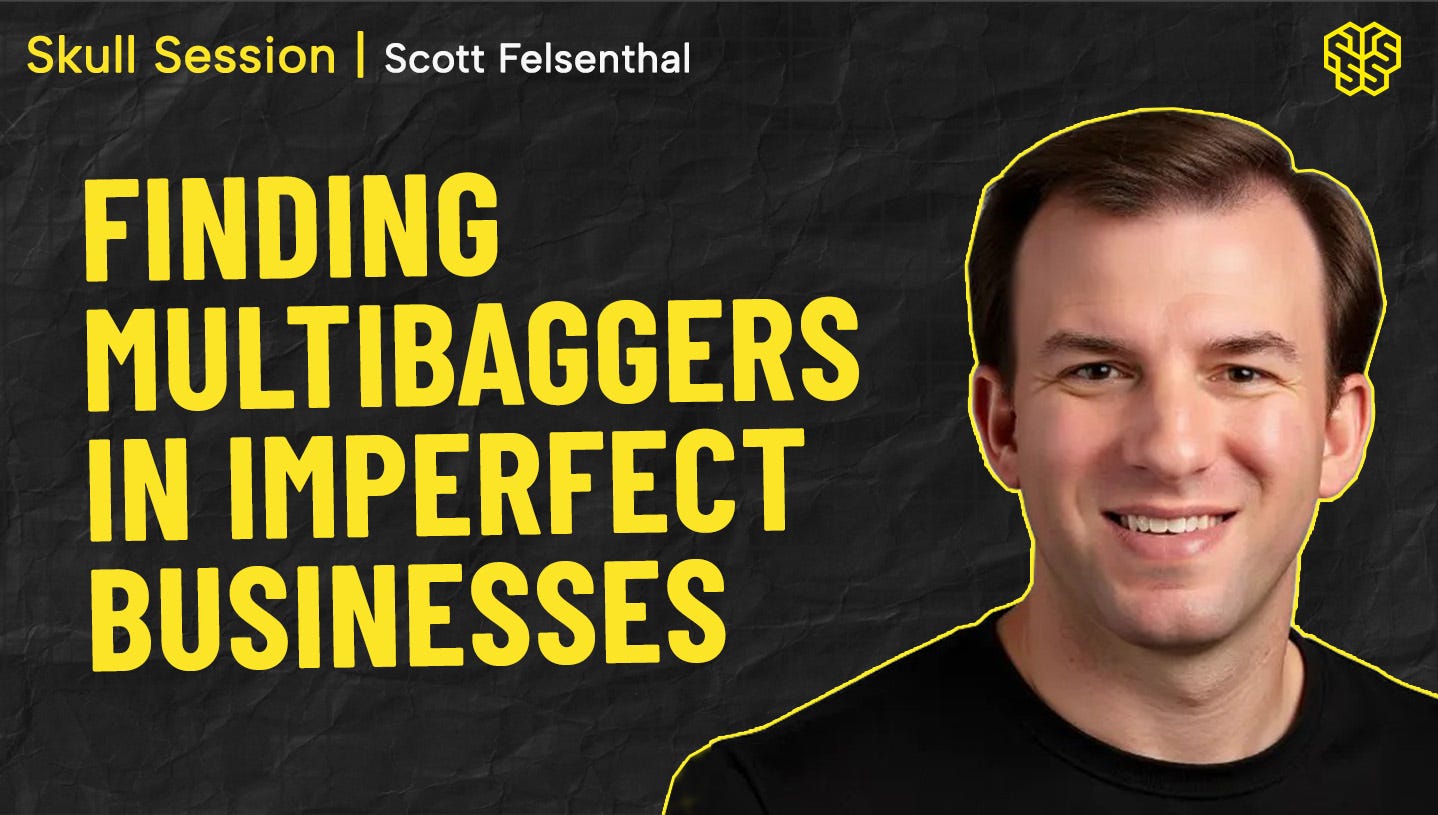
In our previous Skull Sessions interview with Sidecar Investor, we asked him who he’d like to see us interview next. His answer was Scott Felsenthal, who he described as having a “unique combination of experience running private companies and investing in public businesses.”
Scott has spent years on the operating side of business, including more than a decade at Whitmor, a fourth-generation family business where he eventually became CEO. He knows what it’s like to make the decisions investors analyze from the outside: allocating capital, managing people, dealing with customers and lenders, making acquisitions, and navigating difficult periods.
Today, that experience shapes how he invests. Scott isn’t necessarily looking for the perfect business with a flawless track record. He’s looking for companies approaching an inflection point, where the business could look very different a few years from now than the market expects today.
He calls his philosophy “inflection over perfection.” That often means investing before the improvement is obvious in the financials, and being willing to sit through some discomfort while the business catches up with the thesis. I think a lot of us can relate to this from a personal level. Most multibaggers don’t happen overnight, which means you’ll probably have to go through some pain before winning that prize.
But there’s an important distinction: Scott knows that a compelling story alone isn’t enough. He wants to see hard evidence that the company is actually making progress.
His recent writing on Howard Hughes Holdings brought him additional attention when Bill Ackman publicly praised his analysis. He’s also investing in companies like Beeline Holdings (Nasdaq: $BLNE), where he sees the potential for a business transformation that the market may not yet fully appreciate.
I wanted to talk with Scott about how running a business changes the way you evaluate management, how to distinguish a genuine turnaround from a story that never materializes, and why some of the most interesting investment opportunities can be found when a company is still a long way from looking perfect. All these topics relate to the way I invest and encompasses a lot of stocks that I add to the microcap quality index (MSMqi) at my Substack.
Enjoy!
Skull Sessions is a collaboration with Geoinvesting.com, a full-stack microcap research platform and MS Microcaps LLC , home of the Microcap Quality Index (MSMqi)
Generic Questions:
1. How did you first get into investing? Tell us about your journey before and after investing. What is your investing framework and research process like today, and how has it evolved over time?
I remember I bought my first stock (Texas Instruments!) at 12 years old when my dad opened up an Ameritrade brokerage account for me. Little did I know at the time that would be the start of a lifelong passion.
I have always been fascinated by business, and in the public markets especially unusual and under the radar ones that the market has not fully figured out yet or even noticed. My process has evolved a lot over the years as I have been able to apply everything I have learned in running a business and being an operator to investing itself.
Today I am less interested in finding a perfect company and more interested in finding a company that is nearing an inflection point that the market isn’t considering. I look for strong management, meaningful insider ownership, a clean enough balance sheet, improving fundamentals, and some reason the next few years may look very different from the last few.
2. When a new idea enters your radar, what does your research process look like before you’re willing to invest?
I read a lot, and when something strikes my attention I dig in deeper on the company. I generally start with the filings: the 10-K, the last few 10-Qs, the proxy for comp and ownership, and the Form 4s to see what insiders are doing with their own money. I listen to the calls to hear how management talks when things are hard. Then I try to identify the one or two things that have to go right in order for the investment to achieve the outcome I am seeking.
In reality, instinct drives a lot of my investing decisions. My instinct over the years has been influenced by my experiences in owning and running a business and leading it through the good times and the tough ones. I want to understand the numbers, but I am usually most interested when the inflection starts before the numbers fully show it and my instinct is telling me “now is the time to get involved”.
3. If someone asked what makes you different as an investor, what would you say is your edge?
My biggest edge is probably that I look at investments through an operator’s lens. I like to say that operating has made me a better investor and investing has made me a better operator. I wrote an article on X about this that will go deeper into this for anyone interested.
I have spent most of my career actually running businesses, allocating capital, dealing with employees, customers, lenders, inventory, acquisitions, crises, and turnarounds. That gives me a different perspective on what is noise and what actually matters.
I am also very comfortable being early. My investing philosophy is probably best described as “inflection over perfection.” I would rather own something well before the numbers look obvious, which can carry with it some significant pain until the company turns the corner and is discovered, but it’s how I generally choose to invest.
On the flipside, I can say with absolute certainty that investing has made me a better operator. Watching how public companies, often smaller ones, navigate both challenges and opportunities with a lot of perseverance and creativity, sometimes with very limited resources, has given me fascinating lessons to learn from.
Personalized Questions:
4. OK this is gonna be a big one, so take your time. You spent over a decade at Whitmor, a fourth-generation family business, eventually becoming CEO.You’ve gone from running a family-owned operating company to another senior operating role at a national architecture firm. How did your experience as an operator change the way you look at public companies and their management teams? More specifically having sat on the other side of the table as a CEO, how do you evaluate management when you’re investing today? Are there things you can see from the outside as an investor that you simply couldn’t appreciate before running a business yourself?
It changed almost everything.
Running a company teaches you how messy business really is (and every business is messy in its own ways!). As my friend Brent Beshore has said in the past, all businesses are “loosely functioning disasters”. Results often lag the important work by months or even years. From the outside, investors can mistake temporary ugliness for permanent impairment, or mistake a polished presentation for actual execution. I read all of these as signals now. Without having run a business myself, I’m not sure I’d know how to interpret them.
I generally find myself attracted to opportunities in the market that are far from perfect, and where just going from “bad” to “less bad” can mean significant returns. With that in mind, I pay a lot of attention to how management behaves when things are difficult. Are they candid? Do they take responsibility? Are they allocating capital intelligently? Do their incentives align with shareholders? Are they making decisions that may hurt this quarter but strengthen the business three years from now?
Having been a CEO also made me much more forgiving of short term imperfection and much less forgiving of poor judgment. I’ve also served on a public company board, so I’ve seen how hard it is to run a small-cap business while the market watches every quarter.
One more thing I learned firsthand is that it’s lonely at the top. Most CEOs, especially at smaller public companies, don’t have anyone to think out loud with who has sat in that seat and also understands how investors see the business. I didn’t have that person when I needed one. Helping other CEOs work through those moments of both challenges and opportunities is something I’d really enjoy doing more of in the future.
5. Are there subtle things you pay attention to (example: capital allocation decisions, incentives, communication, acquisitions) or something else that don’t necessarily show up in the financial statements?
Insider behavior is a big one. I care about what management owns, what they are buying with their own money, and how they are compensated. I also watch capital allocation closely. Buybacks, acquisitions, debt reduction, dilution, hiring decisions, and even how management talks about mistakes can tell you a lot.
One of the biggest tells is communication. Great management usually have a very clear understanding of what matters, and they tend to get more candid, not less candid, when things are going badly.
6. You’ve developed a following on X through your investment writing, including your recent work on Howard Hughes (NYSE: HHH). Describe that experience for us because I know that Bill engaged with your article which must have been a pretty memorable experience.
I wrote an article on Howard Hughes ($HHH) and I posted the article on X. A few days after I wrote the article, I was out to dinner with my family. After dinner, I picked up my phone and there must have been hundreds and hundreds of notifications from X. It turns out that Bill Ackman reposted my article with a post that read “An excellent and insightful report on $HHH”. Yahoo Finance, Benzinga, Barron’s, and others picked up on Bill’s repost, cited my article, and the stock moved from around $62 to $74 in the days that followed. It felt like the article helped more people discover the transformation underway. What an incredible experience.
I have since communicated directly with Bill as well.
To me, this is just another reminder of how putting yourself out there at times, especially on a platform like X, can drive so much value in fulfilling your passions.
7. If you had to pick one company today that best illustrates the type of investment you find attractive, what would it be? What do you think the market is misunderstanding about it?
A great example is Beeline Holdings (BLNE), which I currently own. Today it is small with a $25M market cap at the time of this writing. The market largely sees it as another small mortgage provider. That is true today, but I think investors are missing what the company is seeking to become.
Beeline has signed a nonbinding LOI to acquire TYTL. Strategically, TYTL matters because it would give Beeline the technology to turn homeowner equity into an institutional investment product serving a huge segment of the population that is home “equity-rich” but cash-strapped. Beeline already has the consumer funnel, mortgage infrastructure, title and settlement capabilities. TYTL could add the digital rails to fractionalize that equity and connect it with institutional capital, thus creating a brand new institutional capital product.
That could move Beeline well beyond originating mortgages and into a broader, more interest rate agnostic housing finance platform.
The CEO owns roughly 16% of the business and over the past few months has purchased close to $1M in stock at prices well above the recent trading range. Another signal, to me, that things are progressing with the TYTL transaction and that his conviction on the future of the business remains quite strong.
It is speculative, but this is exactly the type of investment I am drawn to…a company where what it could become looks very different from what the market believes it is today.
This is not a recommendation or investment advice!
8. A theme that comes through in some of your investment writing is looking for situations where the market may be focused on what a company is today rather than what it could become several years from now. How do you avoid getting caught up in a compelling “future story” that never actually materializes? What are the milestones or pieces of evidence you look for to determine whether a thesis is genuinely playing out?
One of the toughest lessons in investing is learning not to invest in stories. I have been guilty of it, and frankly, I still get too excited about a great story sometimes. I have taken some hits to my overall returns because of it. It can take a very long time for a story to become reality, and in many instances it remains a story forever.
The distinction I try to make today is between a story and a story that is advancing. If management says they are going to do something, I want to see evidence that they are actually doing it.
I am perfectly comfortable investing before the financials look great. In fact, that is usually where I want to be. But the story has to keep earning the right to be believed. If the company stops progressing, you cannot keep rewriting the thesis simply because you love what it could become. At some point, it has to become it!
9. Please give us one person you would like to see us interview.
Someone I have recently met whose story is fascinating is Ben Patton. Ben has a very unique background as he ran a sovereign wealth fund in Abu Dhabi at age 28, built and sold his own company before retiring early, and today is scaling a national beverage brand while actively investing.
Stocks Discussed:
1. Texas Instruments (NASDAQ - TXN): Scott’s first stock purchase at age 12, marking the beginning of a lifelong interest in investing and business.
2. Howard Hughes Holdings (NYSE - HHH): Scott wrote an investment analysis outlining the transformation he sees underway at the company. His article gained wider attention after Bill Ackman praised it publicly on X.
3. Beeline Holdings (NASDAQ - BLNE): A speculative investment Scott currently owns. He believes the market may be overlooking the company’s potential to evolve beyond mortgage origination, particularly through its proposed acquisition of TYTL and the opportunity to develop a new product around homeowners’ equity.