



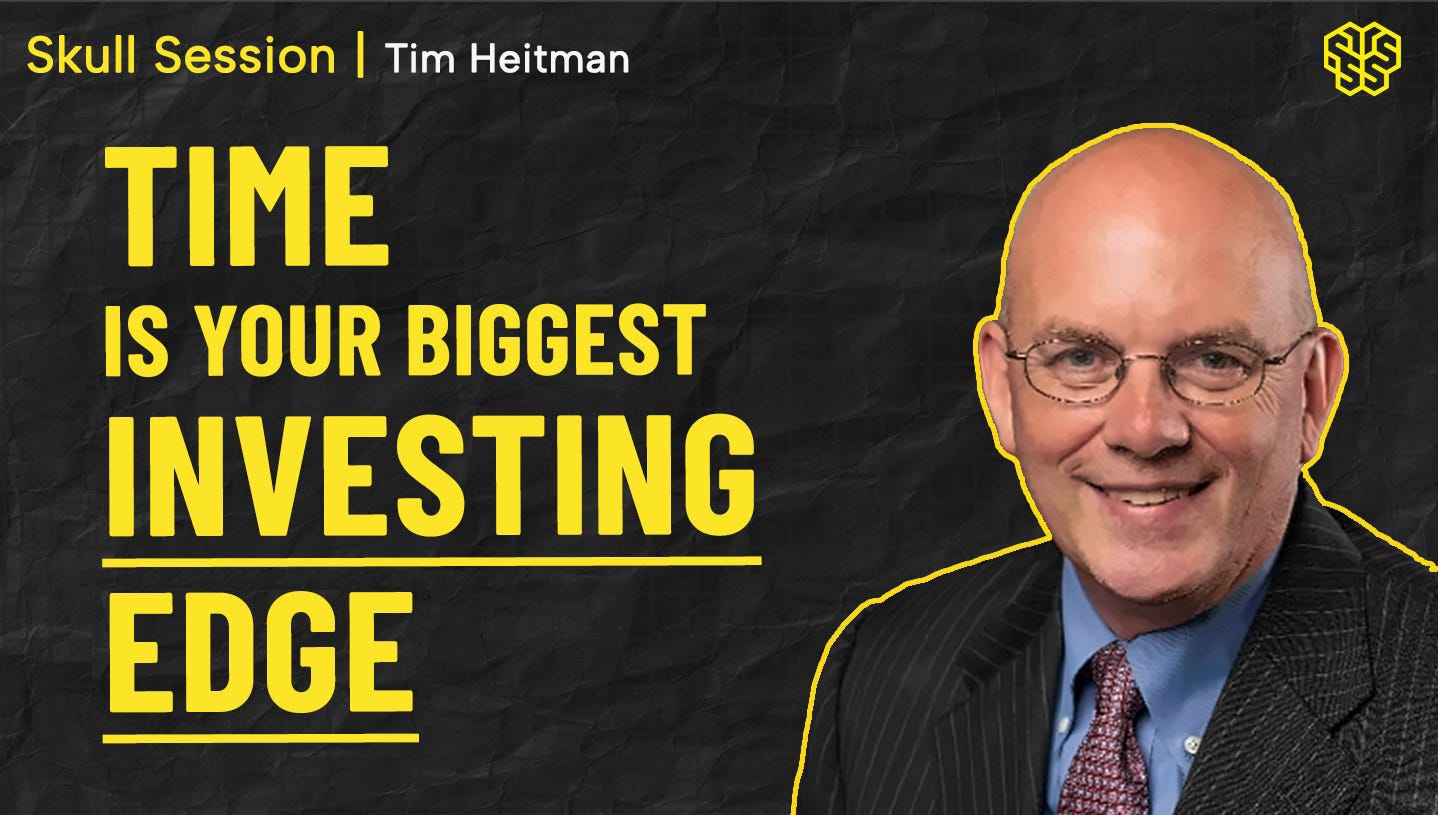
Welcome to the first post of our Investor Notebook Skull Sessions: Written Q&A Sessions.
We’re trying something a little different with Skull Sessions. Over the years, I’ve had the opportunity to speak with a lot of experienced investors who have spent decades studying businesses, markets and a myriad of strategies - from deep value to GARP to special situations. They have had incredible insights to share, but between managing portfolios, doing research and running their own businesses, finding the time for a video interview isn’t always easy. And some would just like to remain anonymous.
So for some of our upcoming Skull Sessions, we’ll be sending a handful of investors a set of questions, partly tailored to their investing journeys and giving them the flexibility to answer them on their own time.
I first experimented with this format by curating some of our video Skull Sessions we do into Q&A format, but I was not extremely happy with the outcome.
I got a front row seat of the written Q&A format when I participated in Edwin’s Dorsey’s Sunday’s Idea Brunch interview series.
I found that many of my answers were a little better thought out, and that I could dive deeper into some areas, where It might seem that I was just rambling on and on during a video interview.
Even though it took me an entire weekend to get it done, I loved it and here is the great thing that happened. It really helped me see my journey in an entirely new light… a sort of therapy session. In a way, it was actually kind of nostalgic.
Tim Heitman is a great person to kick off this format, who I consider a friend, as much as I do a colleague. Tim has been part of the GEO Investing community for some time and has joined us for Video Skull Session interviews in the past, so many of you may already be familiar with him.
This time, rather than doing another video conversation, I wanted to give Tim the opportunity to go deeper on some topics and experiences that have shaped his approach.
He’s been investing for decades and has developed a thoughtful framework around fundamental research, what he calls “time arbitrage” and investing in smaller companies. He loves talking stocks and is great at breaking down businesses and building models. We had our original Skull Session with Tim back in August 2023, before we launched this Substack. You can watch the video at Geoinvesting along with our take on the conversation here or you can watch it on this Substack, here, where we just published the video yesterday.
There’s a lot here for investors at any stage of their journey. Enjoy…
Skull Sessions is a collaboration with Geoinvesting.com, a full-stack microcap research platform and MS Microcaps LLC , home of the Microcap Quality Index (MSMqi).
Interview Questions: Tim Heitman
1. How did you first get into investing? Tell us about your journey before and after investing. What is your investing framework and research process like today, and how has it evolved over time?
I was fascinated with business and companies from the time I was a teenager. My dad worked at John Deere in national sales and marketing, and he would have other managers over to the house. I was the oldest child, so I was allowed to stay up late and talk to the guests about business. I’d also go through the business section and look at the net price changes from the day before and wonder how all that happened. I even bought the board game Stocks and Bonds and played it for hours. I think I still have it. I was so obsessed with business and investing that many of my friends told me that I reminded them of the Michael J Fox character Alex Keaton from the TV show Family Ties.
I started my career at Fidelity, which was, and maybe still is, one of the most respected investment research firms in the business. I was on the retail side and not the investment side, but I was still exposed to all the philosophy and culture. Research focused discipline has been my focus ever since. I used the S&P tear sheets and Value Line back then, and I still use Value Line today.
The market itself has changed more than my process has. In the ’80s, ’90s and 2000s, most volume on the exchanges was driven by fundamental investors buying and selling for what they perceived to be fundamental reasons. Today, it feels like 80–90% of volume comes from quants, momentum, retail, leveraged ETFs, zero-dated options and other technical, non-fundamental order flow. Daily, weekly, even monthly stock movements are much less driven by actual human fundamental investors than they used to be.
The practical result is that larger-cap stocks are now driven more by themes and momentum than by changes in fundamentals, because passive money flow is setting the price for the incremental buyer. Small and microcaps have little exposure to that order flow. It takes much longer for improved fundamentals to show up in the stock price, which is exactly the advantage for investors who focus there. There is also research showing that once a company moves from roughly $100 million in market cap to $500 million, it lands on the radar of all the flows I just described.
Moving down the market cap scale also changes what you have to pay attention to. The smaller the company, the more the business, the management team and the board matter. It is genuinely hard for someone to run McDonald’s badly for very long before they get replaced by someone better. It is much easier for someone to damage a small restaurant chain so badly it never recovers.
One other thing has changed. I never used to go to investor conferences. In the last five to ten years, I’ve started going to several of them. In-person conversations with management teams and with other investors are still enormously valuable. Idea generation has never been easier. Managing the information overload is the actual problem now.
2. If someone asked what makes you different as an investor, what would you say is your edge?
I agree with Maj’s information arbitrage strategy and find it valuable, but I still think one of the biggest edges available is time arbitrage. Turnover rates for funds have certainly compressed from the 1980’s until today. Investor investment time horizons have shortened.
What that means is that because most investors have such short time frames, you get something close to a zero-coupon bond effect. The value accretes to the long-term investor over time. Even if enterprise value never changes, free cash flow builds and the buildup of cash eventually shows up in a higher stock price.
A lot of investors are still only interested in a ticker and a story. If you actually understand the business, its competitors, its management team and its products, you can use short-term volatility to add alpha. I know that sounds like the opposite of what I just said about time arbitrage. It isn’t. If a stock declines significantly due to what is most likely short term issues (orders pushed out, but not cancelled, temporary decline in gross margins for transitory reasons like tariffs) knowing this provides an opportunity to acquire shares at a very good long-term value.
3. When a new idea enters your radar, what does your research process look like before you’re willing to invest?
1. Start with the available work. There are a lot of good resources for a starting-point fundamental read: Substack, GEO Investing, VIC, Microcap Club, Yellowbrick, Buyside, etc.. Idea generation isn’t the constraint it was 15 to 40 years ago, and there are far more detailed company presentations available. You can get up to speed faster than you used to.
2. Talk to management, either at conferences or on Zoom or through an email. I like doing it in an outline form so they can fill in the answers.
3. Read the SEC filings. Not optional.
4. Use Claude to go through transcripts. Go through last 6 earnings transcripts. Look for forward looking statements and evaluate how good management has been at achieving them. Change in the number of analysts on the call (if any) and what are the most common questions. Also look for any macro or industry comments that can be helpful in understanding the business.
5. Maybe build a model to tinker with, but I don’t treat it as the definitive step. Models are helpful, but getting earnings estimates and prices targets correct to the penny is not as important and just having general ranges of outcomes. I also do them by hand.
You need to be comfortable with 70–80% of the story. You are not going to get to 100%, and waiting for it costs you the opportunity.
4. What kinds of companies or investment opportunities are catching your attention right now? Are there any you’re particularly excited about today, and what do you think the market is overlooking?
Preferred stock on hotel REITs. Hotels and New York City real estate generally. Real estate developers. Small food companies. I’ve also been interested in utilities, industrials and defense companies since well before they all became part of the AI / data center / reshoring / Iran trade.
5. You spent many years investing in larger companies before moving into micro and nanocaps. What surprised you most about investing in smaller companies?
How wide the range of quality is in management teams, and in boards.
The bigger surprise was how often independent board members fail to act within their fiduciary responsibility to protect shareholder interests. It happens far more than I expected. I think part of it is the lack of a deep bench of successful activists in the space. Large-cap funds have firms like Starboard, Elliott, JANA Partners and ValueAct keeping boards honest. Down here, there just isn’t the same pressure because they are fewer sheriffs to keep management teams and boards in line.
6. You’ve studied a lot of special situations and turnaround companies. What separates a real turnaround from a company that is simply a declining business trying to tell a better story?
Leadership, and specifically the skill set of the new management team.
If a company has underperformed for a long stretch, it may be because it’s been under-managed… or it may be because the business is inherently poor. Those look similar from the outside and they end very differently.
The piece people underrate is culture. It is incredibly important that the company culture can actually absorb the new ideas and actions the new management team thinks are necessary. And sometimes the answer is simpler than a turnaround at all: the company has finally finished being an R&D development story and the product is genuinely ready to sell. Or many times in the oil and gas space or industrial space, a long-term depressed cycle has changed and now there is a real opportunity to grow the company.
Turning around a small or microcap company is much harder than turning around a large one. Less access to quality management. Less liquidity. Fewer cheap financing options. More competition.
7. You’ve mentioned using conference calls and transcripts as part of your research process. What are you listening for that most investors miss?
A couple of things. I’m mostly interested in what management says about why they’re doing something. I also want their comments on competitors and on the industry. That tells me what they think is important.
Honestly, about half the call is someone reading the press release out loud, which is a waste of time. Another 30% is analysts asking what’s happened since quarter-end so they can fill in their models. Most of the prepared remarks and most of the Q&A focus on the short term, and that is simply not where I’m interested. Which brings it back to time arbitrage.
The best recent example: hotel REIT and NYC office REIT management teams spent more than a year telling investors on calls that conditions were far better than the general perception, and they gave tangible examples. Nobody cared. The narrative was too compelling and the stocks hadn’t performed in years. In spite of the constant news flow about how the consumer is weak or weakening, hotel REITs have gone up 50-100% in the last year.
8. You’ve said that management plays a huge role in your investment decisions. What are some of the qualities you look for in a management team before you’re willing to invest?
Humility. Honesty… meaning they’re willing to own up to past mistakes. Transparency, which usually shows up as being detail-oriented about their own business.
And a successful track record, but with a caveat: they have to be able to show it was their skill set and not just an industry-wide turnaround that carried them. Also, not all CEOs that were successful at large companies are successful at smaller ones. Sometimes it was the team they worked with, the financing that was available, advertising spend, etc. Also, CFOs that become CEOs are generally less successful.
9. Some of the best opportunities can take months (or even years) to play out. How do you stay patient when you believe in the business, but the stock isn’t moving?
Good question. It is very hard to know the difference between wrong and early, and anyone who tells you otherwise hasn’t held enough dead money.
The way I handle it is to separate the stock from the business. The stock not moving is not evidence of anything. In small and microcap, there’s almost no flow-driven buyer, so improved fundamentals can sit there unrecognized for a long time. That’s the whole reason the opportunity exists in the first place. If I let a flat stock price talk me out of a position, I’d be giving away the exact edge I went looking for.
So the question I ask isn’t “is the stock working.” It’s “is the business doing what I said it would do.” My framework is to understand the why, follow the cash, determine the value. Patience comes from re-running that, not from conviction or stubbornness.
Mostly,I follow the cash. Earnings are an opinion; cash is a fact. If the thesis said this business would generate cash and the cash is showing up, I’m early. If the receivables are building, inventories are growing faster than sales, or the earnings keep getting explained rather than converted, I’m probably wrong.
The other half is management. Did they do the things they told me they were going to do? Not “did the results come in,” because timing slips for reasons nobody controls, but did they take the actions they laid out. Capital allocation tells you most of it.
It helps enormously to write down at the beginning what would prove you wrong. Then you’re checking against something you decided when you were thinking clearly, instead of re-arguing the position after it’s gone against you.
Also do what is called a “pre-mortem”. This is figuring out if the company did not achieve their goals over 3-5 years what were the most likely things in management’s control that they failed to do? This gives you benchmarks and signposts to use along the way to continue to evaluate if the original investment theme was correct, or if you are just moving the goalposts or the investment thesis.
10. Seems like you have invested in a good deal of retail and restaurant stocks. Any reason why?
Simple business models that don’t change much over time, which makes them easier to analyze. And you can look at 20 or 30 companies all exposed to very similar fundamentals at once.
That’s the real value. When everyone faces the same conditions, you can actually distinguish between the quality of management teams in the same industry, and you can tell when a company genuinely has a competitive advantage versus when it’s just riding the same wave as everyone else.
11. You worked at Fidelity when Peter Lynch was managing the Magellan Fund. Any good Lynch stories? Were you ever part of any pitch sessions?
I was on the retail side in Dallas, not the analyst side, so I wasn’t in the pitch sessions. But a couple of things from that era have stuck with me.
SCI: One of Lynch’s biggest winners was Service Corporation International, the funeral company. It rolled up the funeral and cemetery business and was a 30x winner from 1976 to 1990. Lynch’s view was that the ideal stock had a boring name, did something disagreeable, and operated in an industry nobody wanted to discuss at a cocktail party. A funeral-home company was almost perfect.
The two-minute drill: Before buying a stock, Lynch made himself explain in two minutes why he was interested, what had to happen for the company to succeed, and what could go wrong. His line was that if you couldn’t explain the story to your family, or to your dog, you probably didn’t understand the investment.
Dunkin’ Donuts, and why customers can out-research analysts: Lynch pointed to Dunkin’ as the kind of opportunity an ordinary investor might spot first. A customer could see that the stores were busy and that new locations kept appearing long before a Wall Street restaurant analyst formally initiated coverage. His argument was never “I like the doughnuts, therefore buy the stock.” It was a sequence: notice the product, determine whether other customers share your enthusiasm, investigate the unit economics and the expansion runway, then check the valuation. The line worth retelling is that by the time the restaurant analyst discovered Dunkin’ Donuts, the customer might already have watched eight stores open in his neighborhood.
The lesson is that local knowledge is valuable, but only when it’s connected to rigorous financial work.
12. Please give us one person you would like to see us interview.
Andrew Rem